The Divine Kulture At-Home Guide
Keep it like the salon.
The at-home guide to washing, moisturizing and styling your natural hair — the way we do it in the chair, written for your bathroom.
The real wash-day order
The exact sequence we use at the shampoo bowl — and the three habits that cause most of the damage we see.
Your product lineup, chosen for your hair
A nine-question match that tells you which type of shampoo, conditioner, leave-in and sealant your hair actually needs.
Styles you can do without heat
Wash-and-go, twist out, braid out and refresh day — plus how to make extensions, presses and keratin last.
Divine Kulture Salon · By appointment · Cibolo, TX
Chapter 01 of 7
1 / 8
The wash day that actually works
Shampoo is for your scalp. Conditioner is for your strands.
Most of the damage I see in my chair didn't come from color or heat. It came from wash day — detangling dry, shampooing the ends, and drying with a cotton towel. Here's the order we use in the salon.
- 01
Detangle before you touch water
Work in four sections, start at the ends and move up. Never pull a knot through — separate it with your fingers first.
- 02
Section into four to six
Sections are how you actually reach your scalp instead of scrubbing the same three inches of hair over and over.
- 03
Warm water to open, cool water to seal
Warm water lifts dirt and opens the cuticle. Your final rinse should be cool — that's what closes the cuticle and gives you shine.
- 04
Shampoo your scalp, not your strands
Put the shampoo on your scalp, massage a full minute with your fingertips (never your nails), and let the suds rinse down your lengths. Your ends get clean on the way out.
- 05
Two washes, not one
The first wash lifts product and buildup. The second is the one that actually cleans. If your hair feels stiff afterwards, you skipped a rinse.
- 06
Rinse until the water runs clear
Leftover shampoo is one of the most common causes of a dry, itchy scalp.
- 07
Condition from your ears down
Conditioner on your scalp is what makes hair greasy by day two. Apply from mid-lengths to ends, then comb it through with a wide-tooth comb while the water is still running — that's your detangling step.
- 08
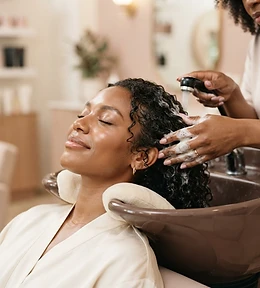
Washing in the shower vs. a sink or bowl
In the shower: apply conditioner, then wash your body while it sits — the steam and stream help it soak into the cuticle. Then rinse per section or all at once with cool water. At a sink or bowl: cover your head with a shower cap for five to ten minutes after applying conditioner, then rinse with cool water.
- 09
Deep condition once a week
Plastic cap, fifteen to twenty minutes, and warmth if you have it — a hooded dryer, a warm towel or a steamer. Warmth is what makes a deep conditioner penetrate instead of sit on top.
- 10
Squeeze, never rub
Microfiber towel or an old cotton t-shirt. Squeeze the water out in sections. Terry cloth and rough rubbing are what cause frizz and split ends.
From my chair
If your hair feels stiff, squeaky or straw-like after washing, your shampoo is too strong for your hair — your hair isn't being difficult.
The product match
Stop guessing at the beauty supply.
Nine questions about your hair, and you'll know exactly which type of shampoo, conditioner, deep conditioner, leave-in and sealant your hair needs — plus several brands that do that job, at every price point. No more buying what didn't work for somebody else.
It takes about two minutes, and it's yours to keep.